
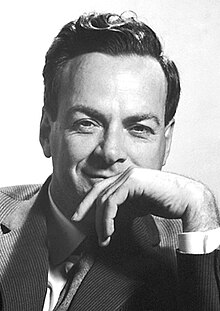
“I had learned to do integrals by various methods shown in a book that my high school physics teacher Mr. Bader had given me. [It] showed how to differentiate parameters under the integral sign — it’s a certain operation. It turns out that’s not taught very much in the universities; they don’t emphasize it. But I caught on how to use that method, and I used that one damn tool again and again. [If] guys at MIT or Princeton had trouble doing a certain integral, [then] I come along and try differentiating under the integral sign, and often it worked. So I got a great reputation for doing integrals, only because my box of tools was different from everybody else’s, and they had tried all their tools on it before giving the problem to me.”
Surely you’re Joking, Mr. Feynman! – 1985
The mathematical trick that is differentiating under the integral sign, more commonly called Feynman’s trick has remained in relative obsecurity over the last half century, however is arguably one of the most powerful tools to solving integrals I have ever studied. This method leverages parameterization, allowing the selection of a specific variable to eliminate a particular component of the integral. However, this approach demands keen observation to be effective, but the necessary skills can be honed through practice. Below we will list a guide as to how to tackle such so-called non-elementary integrals and provide a few examples, with some utilizing both Feynman’s trick and contour integrals to give an in depth comparison as to how the mthod works and why it is so powerful.
Let us first look at a relatively simple example : 


Now, we shall use differentiation under the integral sign – namely, we take partial differentiation inside the integral with respect to 


To summarize what we have done, we can list our procedures of carrying out Feynman’s method for solving integrals as follows :
- Finding the Parameter : We locate a certain parameter suitable for this method which would simplify the original integral. For an integral with the form
, we now write it in this form :
.
- Differentiate Under the Integral Sign: The central idea of Feynman’s technique is to differentiate the integral with respect to such a parameter. Mathematically, you differentiate the integral with respect to this parameter :
.
- Simplify the Differentiated Integral: This step often involves applying rules of differentiation, such as the product rule and chain rule, to the integrand.
- Solve the Differentiated Integral: After differentiating, you should obtain a new integral that is hopefully simpler than the original one. This may involve integrating the new integral or using known techniques for solving integrals.
- Reverse the Differentiation: Finally, you reverse the differentiation by integrating the result back with respect to the parameter. This will give you the solution to the original integral.
The key insight is that differentiating under the integral sign can sometimes lead to a simpler integral that can be solved more easily. This technique is especially useful for tackling challenging integrals and is often associated with Feynman’s unique problem-solving approach. Below we attempt a few more examples :
Example 1 : Evaluate the Gaussian integral 
Solution : Without using Feynman’s Trick, we would usually use double integration and convert it into polar coordinates, this is demonstrated by Kensei Sakamoto. Using Feynman’s Trick however, we define a function 


We now multiply by 


![\frac{d}{dt}[t^{-1}e^{-t^2}I(t)]=\int_0^{\infty}\frac\partial{\partial{t}}\frac{e^{-t^2(1+u^2)}}{1+u^2}\, du](https://s0.wp.com/latex.php?latex=%5Cfrac%7Bd%7D%7Bdt%7D%5Bt%5E%7B-1%7De%5E%7B-t%5E2%7DI%28t%29%5D%3D%5Cint_0%5E%7B%5Cinfty%7D%5Cfrac%5Cpartial%7B%5Cpartial%7Bt%7D%7D%5Cfrac%7Be%5E%7B-t%5E2%281%2Bu%5E2%29%7D%7D%7B1%2Bu%5E2%7D%5C%2C+du&bg=ffffff&fg=000&s=0&c=20201002)
The next step we need to do is to integrate both sides of the equation. This yields the following :

Since we have computed both of these values, it is immediately obvious that 


Example 2 : Evaluate 
Solution : Again, similar to all of the integrals we have discussed, this function does not have an antiderivative. We will first demonstrate how to use contours to solve this problem.
We see that the integral is equivalent to the expression 


Using Cauchy’s integral theorem, we deduce that the contour over the whole loop is zero. Now we split it into three parts : 

Now for 


By subsituting back into the original equation, we obtain the following :

Since we want 


Using Feynman’s trick, we multiply by a parameter 


![I^\prime(a) = -\left[\sin(x) \cdot \frac{e^{-ax}}{-a}\right]_{0}^{\infty} + \frac{1}{a}\int_{0}^{\infty} \cos(x)e^{-ax} \, dx](https://s0.wp.com/latex.php?latex=I%5E%5Cprime%28a%29+%3D+-%5Cleft%5B%5Csin%28x%29+%5Ccdot+%5Cfrac%7Be%5E%7B-ax%7D%7D%7B-a%7D%5Cright%5D_%7B0%7D%5E%7B%5Cinfty%7D+%2B+%5Cfrac%7B1%7D%7Ba%7D%5Cint_%7B0%7D%5E%7B%5Cinfty%7D+%5Ccos%28x%29e%5E%7B-ax%7D+%5C%2C+dx&bg=ffffff&fg=000&s=0&c=20201002)
We subsitute the boundaries and find that ![-\left[\sin(x) \cdot \frac{e^{-ax}}{-a}\right]_{0}^{\infty}](https://s0.wp.com/latex.php?latex=-%5Cleft%5B%5Csin%28x%29+%5Ccdot+%5Cfrac%7Be%5E%7B-ax%7D%7D%7B-a%7D%5Cright%5D_%7B0%7D%5E%7B%5Cinfty%7D&bg=ffffff&fg=000&s=0&c=20201002)

![I^\prime(a) =\frac{1}{a}\int_{0}^{\infty} \cos(x)e^{-ax} \, dx = \frac{1}{a}\left[\cos(x)\left(-\frac{1}{a}e^{-ax}\right)\Bigg|_{0}^{\infty} - \int_{0}^{\infty} -\frac{1}{a}e^{-ax}(-\sin(x)) \, dx\right]](https://s0.wp.com/latex.php?latex=I%5E%5Cprime%28a%29+%3D%5Cfrac%7B1%7D%7Ba%7D%5Cint_%7B0%7D%5E%7B%5Cinfty%7D+%5Ccos%28x%29e%5E%7B-ax%7D+%5C%2C+dx+%3D+%5Cfrac%7B1%7D%7Ba%7D%5Cleft%5B%5Ccos%28x%29%5Cleft%28-%5Cfrac%7B1%7D%7Ba%7De%5E%7B-ax%7D%5Cright%29%5CBigg%7C_%7B0%7D%5E%7B%5Cinfty%7D+-+%5Cint_%7B0%7D%5E%7B%5Cinfty%7D+-%5Cfrac%7B1%7D%7Ba%7De%5E%7B-ax%7D%28-%5Csin%28x%29%29+%5C%2C+dx%5Cright%5D+&bg=ffffff&fg=000&s=0&c=20201002)
![= \frac{1}{a}\left[0 - \cos(0)\left(-\frac{1}{a}e^{0}\right) - \int_{0}^{\infty} \frac{1}{a}e^{-ax}\sin(x) \, dx\right]](https://s0.wp.com/latex.php?latex=%3D+%5Cfrac%7B1%7D%7Ba%7D%5Cleft%5B0+-+%5Ccos%280%29%5Cleft%28-%5Cfrac%7B1%7D%7Ba%7De%5E%7B0%7D%5Cright%29+-+%5Cint_%7B0%7D%5E%7B%5Cinfty%7D+%5Cfrac%7B1%7D%7Ba%7De%5E%7B-ax%7D%5Csin%28x%29+%5C%2C+dx%5Cright%5D&bg=ffffff&fg=000&s=0&c=20201002)

As 


To conclude our long showcase of Feynman’s method, his ingenious approach to integration has shown us that mathematics can be as creative and intuitive as it is analytical. His ‘trick’ serves as a reminder that there are often multiple paths to solve complex problems, and the beauty of mathematics lies not only in its rigorous formulas but in the art of clever insights. Whether you are a physics enthusiast, a mathematician, or simply a curious mind, Feynman’s trick to integration offers a glimpse into the boundless world of creative problem-solving, where the simplicity of an idea can unveil the elegance of the universe’s underlying principles. As we continue to explore the vast landscapes of mathematics, we can draw inspiration from the mind of Richard Feynman, whose legacy reminds us that the journey to understanding is as remarkable as the destination.
Leave a Reply