

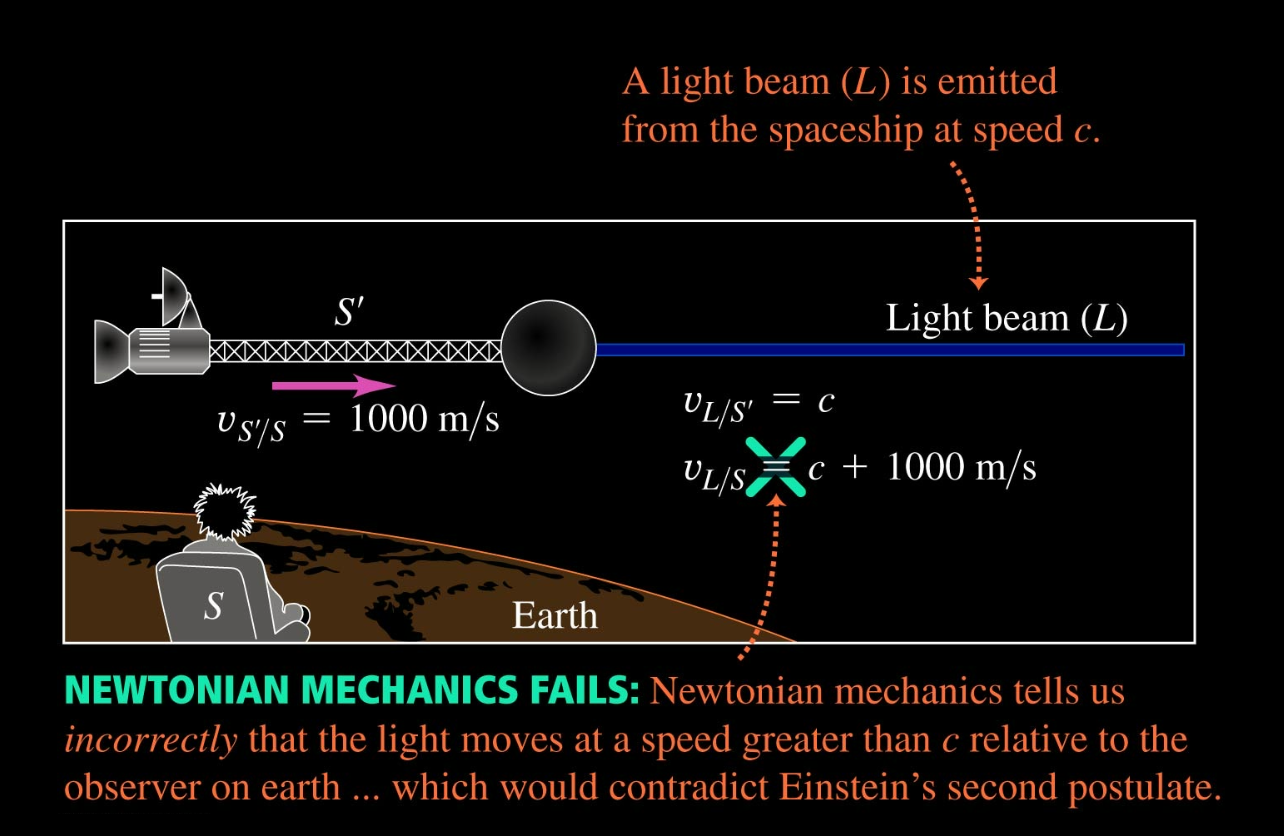
Suppose you are on a spaceship traveling at a speed of 


An intuitive answer would be 
In fact, it turns out this question is unsolvable as posed—it lacks a crucial detail. Specifically, we did not specify relative to which reference frame the speed of the missile should be considered. In physics, particularly in the context of special relativity, the concept of relative motion is key. The speed of an object, such as a missile, can only be meaningfully discussed relative to a particular frame of reference.
Since formulated by Albert Einstein in 1905, special relativity has been an indispensable part of modern physics as we know it today. Among its many profound implications, the concepts of Lorentz factors, time dilation, and the relativistic origin of magnetism are particularly significant. These concepts are essential for comprehending how time, space, and electromagnetic fields behave at velocities approaching the speed of light.
To understand how this discovery came about, we first need to introduce the concept of a reference frame. An inertial frame of reference is one in which Newton’s laws of motion are valid. Specifically, this refers to frames that are either not accelerating or are not being acted upon by external forces. This concept is rooted in Galilean invariance, which states that the laws of physics are the same in all inertial reference frames – this is the reason why you don’t feel the effects of the earth’s rotation.
This amazing fact is what inspired Einstein to ask the following question: Is there a fundamental reason why Newton’s laws cannot detect uniform motion? Could it be that, by the very nature of our universe, no matter what tools or physical phenomena you use, it is impossible to distinguish between an object moving at a constant velocity and one at rest with respect to the universe?
Einstein investigated the implications of being unable to distinguish uniform motion from rest using any experiments involving electromagnetism (light). The answer he arrived at was revolutionary: if we require that the laws of nature have the absolute property of being unable to distinguish between uniform motion and rest, then both distance and time must become relative concepts.
This means that the length of time between two events, as well as the distance between them, depends on the observer’s state of motion. Einstein realized that if Maxwell’s equations—describing electricity and magnetism—remain the same in all inertial reference frames, then uniform motion could not be detected by any experiments involving these phenomena.
Specifically, Einstein noted that if Maxwell’s equations are indeed identical in all inertial frames, then the speed of light must also be the same in all such frames, regardless of the motion of the objects sending or receiving the light signal. For example, the speed of light relative to you remains constant, whether you are moving in the same direction as the light beam or in the opposite direction.
This principle leads directly to the concept of time dilation, where time itself is affected by the relative motion of observers, ensuring that the speed of light remains constant across all inertial reference frames.
In particular, to understand how these change based on their respective velocities, we need to introduce a factor to quantify this. The Lorentz factor 
The Lorentz factor is defined as:

The Lorentz factor becomes much more significant at velocities close to the speed of light. As the velocity 
One equation involving the Lorentz factor is the formula for time dilation. This describes how the time perceived in different locations may differ. This phenomenon is expressed by the equation:

Where 

For instance, if an astronaut travels at a speed of 

Thus, if one year passes on Earth (
While time dilation affects the perception of time, Lorentz contraction affects the perception of length. Objects moving at high velocities appear shorter in the direction of motion to a stationary observer. The length contraction formula is given by:

Where 

Special Relativity not only revolutionized our understanding of space and time but also provides deep insights into the nature of electric and magnetic fields. One of the fascinating outcomes of Special Relativity is the explanation of magnetism as a relativistic effect of electric fields.
In the framework of Special Relativity, the Lorentz transformation describes how quantities change when viewed from different inertial frames moving at a constant velocity relative to each other. For electric fields, this transformation can lead to the appearance of magnetic fields in moving reference frames.
Consider a wire carrying an electric current. In the wire’s rest frame, the moving electrons create an electric field, and due to their motion, a magnetic field arises. However, this can be viewed in a different frame to understand the relativistic origin of magnetism.
To illustrate this, let’s use a simple example involving a long, straight wire carrying a steady current 
However, from the perspective of an observer moving alongside the electrons (thus, at rest relative to the electrons), the electrons are stationary, but the positive ions in the wire are now moving. Due to Lorentz contraction, the density of the moving positive ions appears increased compared to the stationary negative electrons, creating a net positive charge density. When transforming back to the lab frame (where the wire appears electrically neutral), this relativistic change in the electric field components due to the motion of charges manifests as a magnetic field.
In a more mathematical sense, the Lorentz transformation of the electric field 


Where 

Special Relativity, through the Lorentz factor, time dilation, and the relativistic origin of magnetism, provides a comprehensive framework for understanding how time, space, and electromagnetic fields are interconnected and vary with velocity. These concepts challenge our intuitive notions of time, space, and fields, revealing the relative nature of these fundamental quantities. The insights gained from Special Relativity are not just theoretical constructs but have practical applications in modern technology and have been confirmed by numerous experiments. As we continue to explore the universe at increasingly higher velocities and finer scales, the principles of Special Relativity will remain indispensable in guiding our understanding of the cosmos.
Leave a Reply